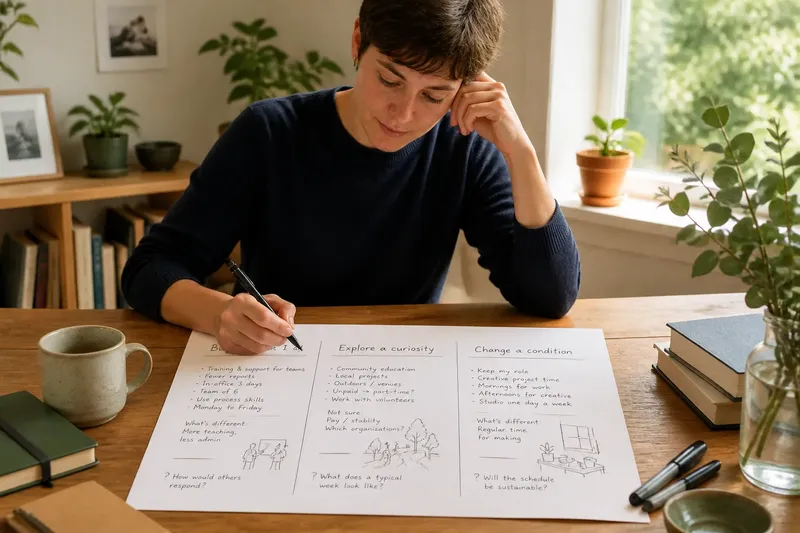
The One-Week Trial: Test an Idea Before You Adopt It
A one-week trial turns a vague life change into a bounded experiment, helping you spot practical fit, hidden friction, and the next question worth asking.
The common mistake with a promising new idea is to treat the first decision as permanent. You sign up, rearrange your routine, or announce a new direction before learning what the ordinary version feels like. A one-week trial lets you examine one small part before the idea gathers obligations.
A one-week trial is not a rehearsal for an entire new life. It is a way to check a specific assumption: whether an activity fits a real day, whether its trade-off feels acceptable, or whether an unfamiliar path merits another look. The useful result is a better next decision, not a verdict on your character.
What can a one-week trial tell you?
A short trial can reveal friction that an appealing idea hides. Perhaps the activity is interesting but the timing is poor. Perhaps you enjoy the work but not the setting. A bounded attempt can help separate those details before you make a larger commitment.
It cannot tell you how a choice will feel under every circumstance. A week spent browsing job listings, for example, cannot answer whether a career change would suit you. It might clarify which skill you want to explore or whether conversations with people in that field leave you curious.
Choose an action that does not create unwanted obligations for other people or put your health, finances, or safety at risk. For consequential choices, a trial can inform your thinking, but it does not replace qualified professional advice.
Which kind of trial fits your question?
Would a routine trial fit this habit into my day?
A routine trial adds one modest action at a predictable point in your day. It can help answer whether you enjoy drawing before dinner or whether a short walk after work gives you a useful transition.
Attach the action to a cue you already encounter, such as closing your laptop or putting the kettle on. Notice whether it fits the day you actually have, not just the day you imagine having.
Would a substitution trial reveal the trade-off?
A substitution trial temporarily replaces one familiar activity with another. It suits a question such as whether using an evening hour for a class feels worthwhile in place of television.
Keep the rest of the routine steady where practical. Record what the new activity offered and what you missed. If you change the activity, timing, and company all at once, the notes will have the clarity of a drawer full of cables.
Would an information trial clarify an unfamiliar path?
An information trial gathers experience before you alter your routine. You might attend an introductory class, speak with someone who does the work, or try a sample task with ordinary materials.
Ask about the ordinary parts as well as the polished ones. “Do I enjoy the patient, detailed work?” is easier to examine than “Is this my future?”
How do you design a bounded trial?
Write down the decision you are considering, then turn it into a question that a week can reasonably inform. “Should I change my whole schedule?” is too broad. “Does reserving one evening for language practice feel workable?” gives you something observable.
Set the boundary before you begin. Decide what you will do, when you will do it, what you will leave unchanged, and when the trial ends. Choose a stopping point based on the calendar, not on whether you have reached the answer you hoped for.
Say you are curious about volunteering at a community garden. You arrange one visit, choose a task that carries no continuing commitment, and note afterward which parts interested or drained you. If the visit leaves you wanting to ask about another task, that is a useful next question. If the timing or physical setting feels unsuitable, you have identified a constraint without promising to return.
What should you note during the week?
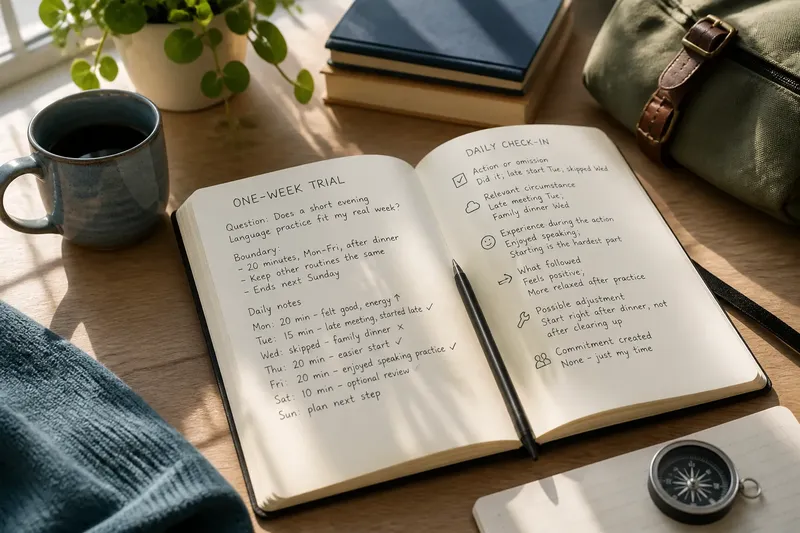
Use a phone note, paper calendar, or notebook you already reach for. Keep entries brief. After an attempt—or at the end of the day—record:
- Action or omission: Note what you did, or the concrete reason it did not happen. If the same obstacle recurs, decide whether to adjust the timing; if it reflects a lasting constraint, consider setting the idea aside.
- Relevant circumstance: Record something that affected the attempt, such as a late meeting. If it was unusual, treat the result cautiously; if it is part of a normal week, count it as a real condition the plan must accommodate.
- Experience during the action: Note interest, attention, or reluctance. If interest persists despite effort, consider another trial; if the process consistently feels unwanted, consider a different version or set it aside.
- What followed: Describe any immediate effect you noticed on mood, energy, or the next activity. If the effect supports what you hoped for, keep it as a reason to explore further; if it makes the rest of the day harder, consider changing the timing or scale.
- Possible adjustment: Name one change you would make next time. If that change addresses a specific obstacle, decide whether to repeat with that adjustment; if you cannot name a relevant change, review whether the activity itself is a poor fit.
- Commitment created: Note any obligation, cost, or expectation involving someone else. If the commitment exceeds the boundary you set, stop or renegotiate before continuing; if it remains within the agreed scope, proceed to the planned end date.
Separate observation from interpretation. “I started after a late meeting and stopped when dinner was ready” describes what happened. “I cannot stick with anything” turns one evening into a personality assessment. The second note is not more informative for being more dramatic.
How do you decide what the notes mean?
Read the entries once the week ends. Look for repeated conditions, not a grand final feeling. Did the action fit one part of the day better than another? Was beginning harder than continuing? Did an obstacle recur? Did the ordinary task match the version you had imagined?
Then choose a next move:
- Continue: If the action fit well enough and you want more information, decide what the next bounded attempt should clarify.
- Adjust: If the idea still interests you but timing, scale, or setting caused trouble, change one feature and keep the question steady.
- Set aside: If the trial exposed an unwanted cost or a poor fit, make no further commitment for now. You can revisit the broader possibility later.
If the week was unusually disrupted, mark that limitation rather than quietly changing the question afterward. A repeat may be useful when one specific, changeable condition obscured the answer. If the record is already clear enough to choose a next move, another week may add little.
What questions help you read the result?
What if I miss several planned attempts?
Write down what prevented each attempt and whether that obstacle belongs to ordinary life. If the week was unusually disrupted, treat the result as limited; if the conflict is routine, decide whether the action needs a different place in your schedule.
Should I repeat the trial?
Repeat it if one specific, changeable feature made the first attempt hard to interpret, such as an awkward time or unfamiliar setting. Change that feature alone so you can see whether it alters the experience.
Can one week settle a major life decision?
No. It can identify a practical constraint or an appealing part of a larger choice, but it cannot represent every circumstance the choice would involve. Use what you noticed to decide whether a conversation, further exploration, or professional advice is appropriate.
What if the notes point in different directions?
Keep both observations. You might enjoy the activity and dislike its timing, or value the result while finding the process tiring. That combination may suggest a narrower adjustment than a simple yes or no.
How do you choose the next move from a one-week trial?
Match the next move to what remains unclear. If you need to know whether an activity fits daily life, try a routine version. If you need to understand what it displaces, use a substitution. If the option is still unfamiliar, gather information before rearranging your week.
Imagine that Lena is considering an evening ceramics class. Her starting point is a regular evening spent at home and an interest in making things, but she does not know whether the class itself appeals to her. She first writes the question, “Do I enjoy working with clay in a shared class setting?” Then she finds a single introductory session that does not require an ongoing enrollment, attends it, and notes afterward that she liked shaping the clay but found the group setting distracting. Her resulting decision is to try a brief session in a quieter setting before deciding whether she wants a regular class. The trial did not answer whether ceramics belongs in her life; it separated the material from the setting.
When two questions seem relevant, test one at a time. Changing your evening schedule while starting a new class can make it hard to tell which change mattered. Leave the second question for a later decision.
How can you keep the trial easy to stop?
Check what the action commits you to before starting. Prefer a drop-in activity over an ongoing membership, a borrowed tool over a purchase, or a short conversation over announcing a new direction. Make the exit plain: return to the previous routine, cancel a temporary arrangement, or make no further commitment.
Other people’s time matters too. If a trial involves a colleague, friend, or volunteer group, explain its temporary scope and honor any commitment you do make. Reversible for you should not mean confusing for everyone else.
A one-week trial is most useful when the question is small enough to observe and the next decision is yours to make. Keep the record plain, count ordinary friction as part of the picture, and let the result point toward a specific next move. When you revisit a one-week trial later, note what has changed in your circumstances before treating an old answer as current.