Three Future Sketches, One Blank Page
Three future sketches help you compare distinct directions, spot assumptions and identify what to learn next, without turning a first draft into a decision.
The common mistake in making three future sketches is to turn the first plausible path into a polished plan. That leaves little room to notice what else might suit you, and the polish can make an untested idea feel settled. A blank page can help you compare directions without pretending to predict the future.
Use one sheet of paper, a pen, and a quiet stretch of time. Draft three ordinary weeks that differ in meaningful ways. The point is to see what each direction contains, what remains unknown, and what small question you might explore next.
Why sketch three possible futures?
A familiar direction usually comes with ready-made details: a role, a routine, a route you can explain. Other possibilities may sound vague simply because you have not pictured their daily texture yet. Giving each direction its own space makes that difference easier to see.
These sketches are not competing plans. One can extend your current work, another can follow a curiosity, and a third can change a basic condition such as your setting or schedule. Treating them as distinct drafts helps expose assumptions before you spend effort defending one.
Begin with directions that would produce different kinds of ordinary days.
What should each sketch include?
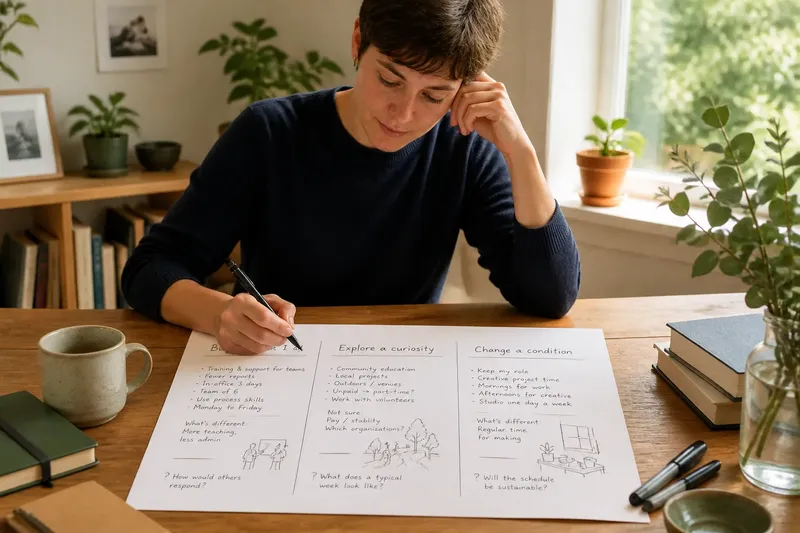
Divide the page into three columns, or use three sheets. Give each sketch a plain title. Then describe a typical week: what you do, where you do it, who you spend time with, and what differs from your current routine.
Prefer details you can picture over broad labels. “Help people” could mean many things; “teach a small group and spend less time preparing reports” suggests a recognizable day. Include only details that help distinguish one direction from another.
Mark uncertain parts directly. Write “perhaps,” “not sure,” or “would need to ask” beside assumptions. A sketch can show a plausible picture without claiming that every part is feasible or known.
How do you keep the three directions distinct?
Give each draft a different starting point. One might build on a skill you already use. Another might explore an interest you have postponed. For the third, change one condition you normally take for granted, such as the location, rhythm, or kind of contribution involved.
Avoid assigning the columns roles like “best,” “safe,” and “wild.” Those labels smuggle in a ranking before you have described the options fairly. If two drafts sound alike, change a condition that would alter the actual week, not just the title.
Say you work in administration and are wondering what to do next. In the first sketch, you stay in the field and spend more time training colleagues. In the second, you explore community work, while marking the setting and responsibilities as unknown. In the third, you keep your occupation but reserve regular time for a creative project. The result is three different weekly patterns, each with a question to investigate; none is a verdict about what you should choose.
What are the steps for drafting the page?
- Choose a time horizon. Write a period you can picture on the page. If you cannot describe an ordinary week at that distance, choose a nearer horizon; if the draft feels like a description of next Tuesday, widen it.
- Draft the familiar direction. Write what continues and what changes. If the sketch is only a list of current duties, add one change; if it already suggests a distinct week, move on.
- Draft the curious direction. Name an interest you have not seriously explored and describe what a week around it might involve. If the idea remains a label, add an activity or setting; if it depends on unknown facts, mark them rather than guessing.
- Draft the assumption-changing direction. Alter one condition, such as location, schedule, or contribution. If the new version still describes the same daily life, change a different condition; if its ordinary week differs, keep it.
- Give each sketch a neutral title. Use a few words that identify its central feature. If the title ranks or dismisses the option, replace it with a descriptive one; if it distinguishes the direction, leave it.
- Mark open questions. Put a question mark beside details that need information or a conversation. If a detail is an assumption, label it; if it is something you already know, write it plainly.
- Pause before comparing. Set the page aside until another session. If one draft is much longer, add enough detail to the others to make their ordinary weeks visible; if all three are distinguishable, compare them later.
How should you compare the sketches later?
Read each draft once without editing it. Compare the days they describe, not how persuasive or polished the writing sounds. Notice what draws your attention, what seems demanding, and what you cannot yet picture.
Under each column, complete one sentence: “I want to learn more about…” or “I would need to understand…”. If a sketch raises a clear question, keep that question; if it remains too vague to examine, add a concrete detail before drawing a comparison.
Use the page to decide what to ask next, not to score your possible selves.
What can three future sketches tell you?
Do three future sketches need to be realistic?
They need to be imaginable, not fully verified. Keep details that help you picture an ordinary day, and mark assumptions that need checking instead of treating them as facts.
Should all three directions be equally appealing?
No. They should be distinct and described fairly, not equally attractive. If one feels unappealing, check whether you have described a real direction or only a thin label.
What if two sketches are too similar?
Identify the condition they share, then change one element that would alter the daily routine. If the revised draft still produces the same kind of week, choose a different starting point.
What can’t a future sketch tell you?
A sketch cannot establish whether a role, schedule, or setting will work in practice, and it cannot account for every change in your circumstances. It can show which assumptions need information and which questions deserve a conversation or a small, reversible exploration.
When should you set the page aside?
Stop when each sketch shows a recognizable ordinary week and its main unknowns. If one column has grown into a detailed plan while another is still a phrase, add only enough to make the comparison fair. More polish is not the same as more useful information.
Keep the page, revise it, or leave it alone as circumstances change. Three future sketches are a snapshot of what you can imagine now, not a forecast or an obligation. The phrase “three future sketches” is most useful when it leads to a clear next question, such as whom to talk to or what detail to verify, rather than another round of editing.